
.svg)


It's done
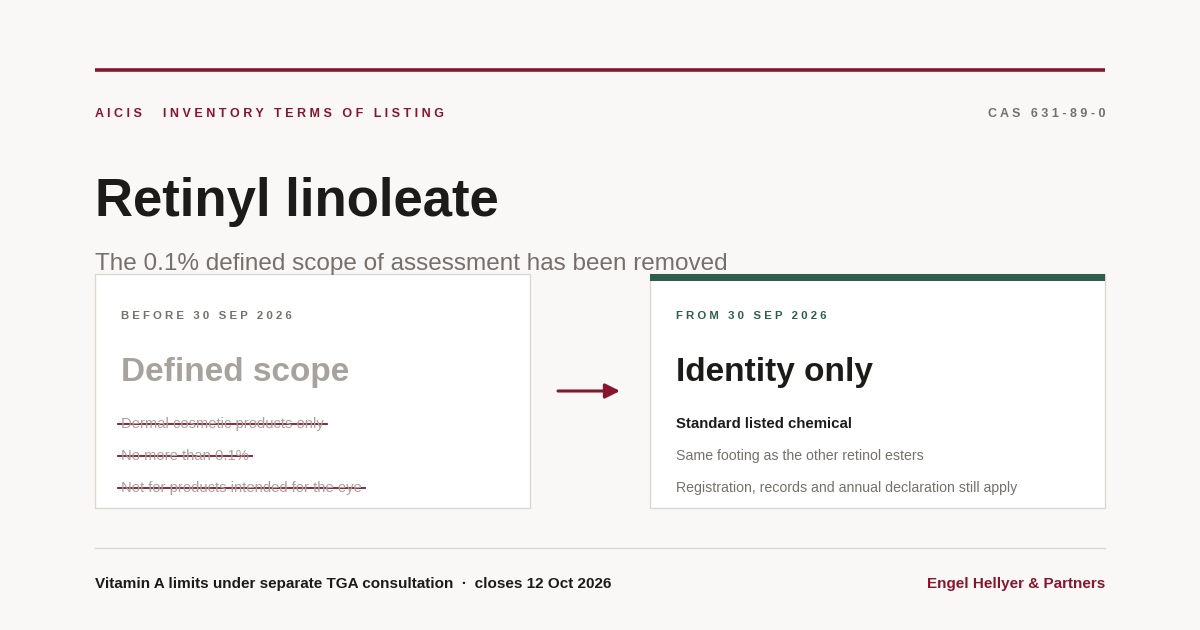
A few weeks ago we reported that AICIS intended to cancel the defined scope of assessment attached to retinyl linoleate (CAS 631-89-0). That change took effect today, 30 September 2026.
The Australian Inventory of Industrial Chemicals listing for retinyl linoleate now shows only its chemical identity — CAS number, CAS name and molecular formula. The terms that caused the trouble — use in dermal cosmetic products at no more than 0.1%, and not in topical products intended for the eye — no longer appear.
Retinyl linoleate now sits on the Inventory as a standard listed chemical, on the same footing as the other retinol esters.
Why that matters
Under the old terms, introducing retinyl linoleate above 0.1% took it outside its Inventory listing. It was treated as a new chemical for categorisation purposes, PIRs lodged for Reported introductions above that level stopped being valid from 26 June 2026, and AICIS began issuing compliance notices to affected introducers.
With the defined scope removed, that trap has gone.
AICIS's own explanation on the Inventory page is straightforward: where a chemical's terms of listing contain only chemical identity information, it can be imported or manufactured without notifying AICIS first — provided the introducer is registered.
For businesses caught out in June, that is a genuinely good outcome, and a relatively quick one.
What still applies
A cleaner listing is not the same as no obligations. Four things remain.
Registration and records. You must still be registered with AICIS, keep records about the chemical under the requirements for the listed introduction category, and submit your annual declaration at the end of the registration year.
The hazard finding stands. AICIS's evaluation of retinol and retinol esters (EVA00187) concluded the group is expected to cause adverse effects on the development of the unborn child. Removing a term of listing does not change that conclusion.
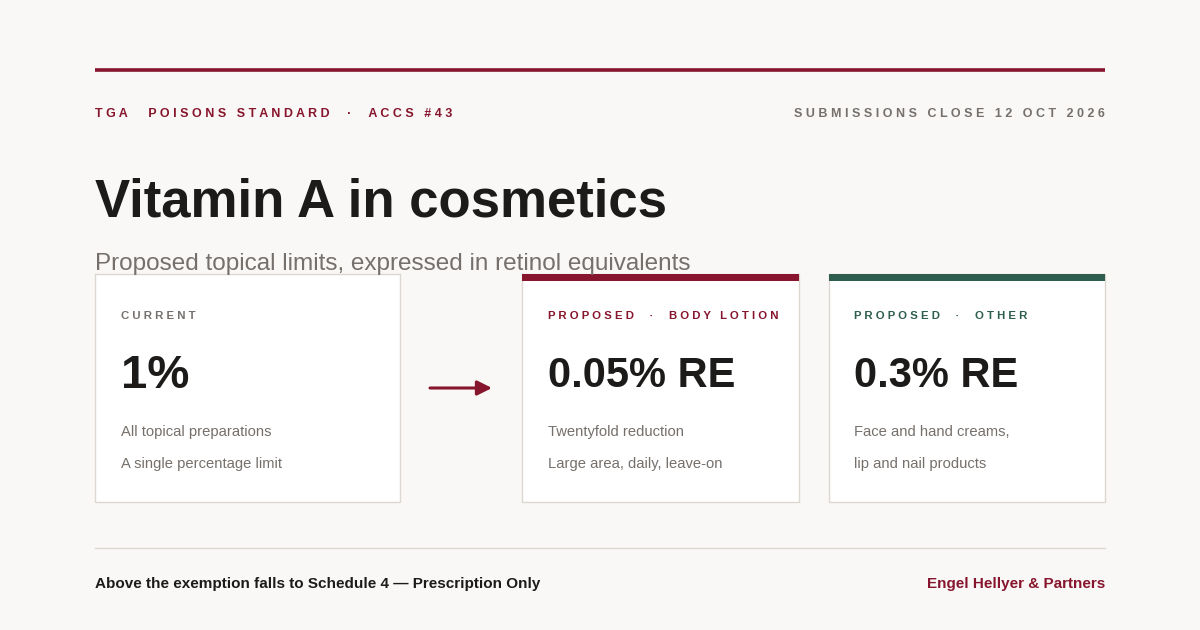
The Poisons Standard is separate — and may tighten. Vitamin A, which covers retinol and its esters, is currently in Schedule 4 with an exemption for topical preparations at 1% or less. The TGA is now consulting on replacing that with 0.05% retinol equivalents in body lotion and 0.3% retinol equivalents in other topical preparations. Submissions close 12 October 2026. AICIS has opened the door; the Poisons Standard may narrow it.
Past introductions. The variation changes the position going forward. If you received a compliance notice for introductions made while the defined scope applied, take advice on where that leaves you rather than assuming the change resolves it.
One evaluation, three consequences
It's worth seeing the whole sequence together. A single AICIS evaluation of retinol and retinol esters has, in three months, produced:
- a defined-scope problem for retinyl linoleate that invalidated PIRs in June
- the removal of that defined scope, now reflected on the Inventory
- a proposed rewrite of the vitamin A entry in the Poisons Standard, affecting every retinol product on the market
Different regulators, different instruments, months apart — all flowing from one document. That's why we track evaluations, Inventory variations and scheduling proposals together rather than as separate events.
What to do now
- Check the current Inventory listing for retinyl linoleate and any other ingredient where your categorisation relied on specific terms of listing.
- If you received a compliance notice, get advice on your position for the period the defined scope applied.
- Recalculate your retinol and retinol ester products in retinol equivalents against the proposed Poisons Standard limits, and consider a submission before 12 October.
- Keep your registration, records and annual declaration in order — those obligations are unchanged.
How Engel Hellyer & Partners can help
We monitor AICIS evaluations, Inventory listings and their terms, variations and Poisons Standard decisions for our clients, and assess what each change means for their specific formulations.
Between us our directors bring around a century of combined regulatory experience across AICIS, the TGA and the Poisons Standard, including time inside the industrial chemicals regulator itself.
If you use retinyl linoleate or other retinol esters, we're happy to take a look.
This article is general information only and does not constitute regulatory advice for any specific product or introduction. Listings, requirements and proposals change; confirm the current position before acting.
Further reading
Primary sources:

.svg)