
.svg)


The problem we flagged in June is being fixed
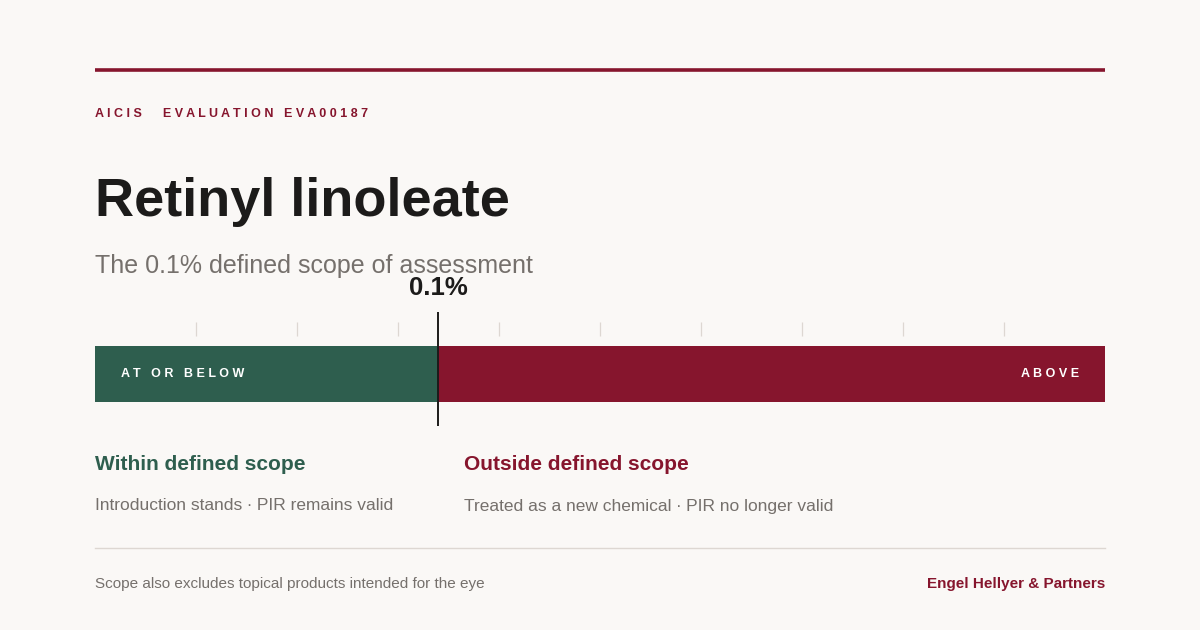
In June we wrote about an unwelcome surprise buried in AICIS's evaluation of retinol and retinol esters (EVA00187): retinyl linoleate (CAS 631-89-0) carried a defined scope of assessment on its Inventory listing, limiting it to dermal cosmetic products at no more than 0.1%, and excluding topical products intended for the eye.
Introduce above that limit and the chemical fell outside its listing, was treated as a new chemical for categorisation purposes, and any Pre-Introduction Report resting on a Reported introduction stopped being valid. AICIS began issuing compliance notices to affected introducers.
At the time, AICIS itself acknowledged the awkwardness: it noted that the risks identified in the evaluation, and the measures proposed to manage them, applied to all the retinol esters in the group — which meant retinyl linoleate's individual term of listing was no longer aligned with the regulator's own risk assessment. A future variation was flagged as necessary.
That variation is now happening. AICIS has announced it will cancel the defined scope of assessment condition attached to the retinyl linoleate listing.
What this changes
Once the variation takes effect, the 0.1% concentration ceiling and the eye-product exclusion fall away as terms of the Inventory listing. Retinyl linoleate will sit on the same footing as the other retinol esters covered by the evaluation — retinol, retinyl palmitate, retinyl acetate and retinyl propionate — none of which carried an individual defined scope.
In practical terms, the specific trap that invalidated PIRs above 0.1% is being removed. For introducers caught out in June, that is genuinely good news.
What it does not change
This is where it pays to read carefully, because "restriction removed" is not the same as "no obligations."
The hazard classification stands. The evaluation concluded that this group of chemicals is expected to cause adverse effects on the development of the unborn child, with sufficient evidence to warrant classification as human developmental toxicants. Removing a term of listing does not remove that finding — and a reproductive or developmental toxicity classification is precisely the kind of hazard that drives categorisation outcomes.
Categorisation still has to be done properly. Your introduction category must reflect the chemical's actual hazard profile. The removal of the defined scope changes the listing position; it does not hand you a lower-risk category by default.
The Poisons Standard is separate. The vitamin A entry in the SUSMP, and the recommendation arising from the evaluation to amend it, operate independently of the Inventory listing. Satisfying AICIS does not satisfy the Poisons Standard.
Timing matters. Until the variation formally takes effect, the existing terms of listing continue to apply. If you are above 0.1% today, you are still outside scope today.
What introducers should do
- Confirm the effective date of the variation before changing anything — the announcement and the variation taking legal effect are not the same moment.
- If you received a compliance notice, take advice on where that leaves you for the period before the variation applies. A change going forward does not automatically resolve a past position.
- Re-check your categorisation against the group hazard classification rather than assuming the old category simply resumes.
- Keep the SUSMP position in view, particularly if any amendment to the vitamin A entry proceeds.
The wider point
Two months, two decisions, opposite directions. In June a term of listing invalidated introductions overnight; now that same term is being cancelled. Neither change was signalled far in advance, and both were published in documents most introducers had little reason to read closely.
That is the reality of operating under AICIS: the position can move underneath a compliant business without warning, in either direction. Monitoring is not administrative housekeeping — it is how you avoid finding out from a compliance notice, and how you know when a restriction has lifted and an opportunity has reopened.
Where we fit in
We track AICIS evaluations, Inventory listings and their terms, variations, the Rolling Action Plan and Poisons Standard decisions on behalf of our clients — so that a change like this is something we bring to you, with an assessment of what it means for your specific formulations.
Between us our directors bring around a century of combined regulatory experience in this area, including time inside the industrial chemicals regulator itself, so we read these decisions with a sense of how they will be applied in practice, not just what they say.
If you use retinyl linoleate, were affected by the June position, or would like your introductions reviewed against the current listings, we're happy to take a look.
This article is general information only and does not constitute regulatory advice for any specific product or introduction. Requirements, listings and effective dates change; confirm the current position before acting.
Further reading
Primary sources from AICIS:

.svg)