
.svg)


The biggest change to retinol in cosmetics in years
The TGA has opened a pre-meeting consultation on a Delegate-initiated proposal to amend the Poisons Standard entry for vitamin A, referred to ACCS #43 in November 2026. Submissions close close of business, 12 October 2026.
If you sell retinol or retinol ester products in Australia, read this one properly. It proposes two changes, and the second is as significant as the first.
What's proposed
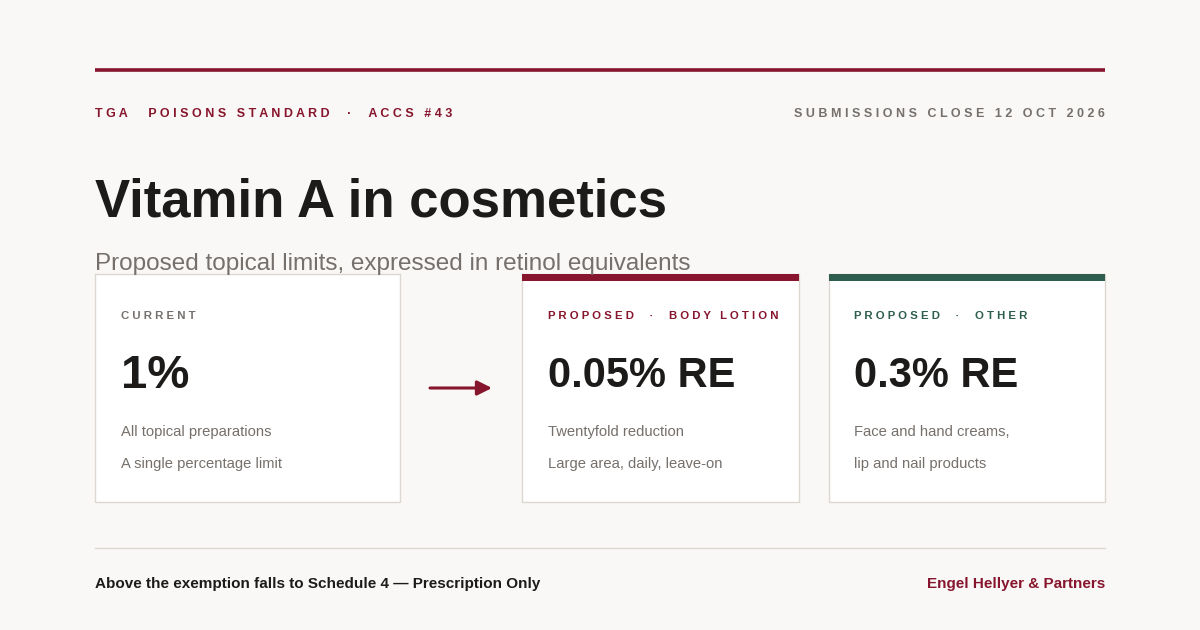
Vitamin A for human therapeutic or cosmetic use currently sits in Schedule 4 — Prescription Only, with an exception for preparations for topical use containing 1% or less. That single 1% figure is what the cosmetics industry has worked to.
The proposal replaces it with a tiered exemption expressed in retinol equivalents (RE):
- topical preparations containing 0.05% RE or less in body lotion; or
- other topical preparations containing 0.3% RE or less; or
- preparations for internal use containing 3,000 µg RE or less per daily dose; or
- preparations for parenteral nutrition replacement
For body lotion, that is a twentyfold reduction. For other leave-on topicals, better than threefold. Anything above the relevant exemption falls into Schedule 4 — Prescription Only, which is not a labelling outcome. It is the end of the product as a cosmetic.
The second change: percentage becomes retinol equivalents
This is the part that will catch formulators out.
Today the limit is a flat percentage of vitamin A. The proposal expresses it in retinol equivalents — and the notice is explicit that different retinol esters correspond to different RE values, and therefore contribute different amounts of vitamin A activity.
So you cannot simply read your existing percentage across. A formulation at, say, 0.3% retinyl palmitate does not carry the same RE as 0.3% retinol. Every affected product needs its RE calculated properly, and a product that looks compliant on a percentage basis may not be on an RE basis.
The Index entry is also proposed to be amended to cross-reference the five chemicals explicitly: retinol (CAS 68-26-8), retinyl palmitate (79-81-2), retinyl acetate (127-47-9), retinyl linoleate (631-89-0) and retinyl propionate (7069-42-3). That removes any argument about what the vitamin A entry captures.
Why the TGA is proposing it
The proposal flows from the AICIS Evaluation Statement on retinol and retinol esters — the same evaluation that produced the retinyl linoleate defined-scope issue we wrote about recently.
Retinol and retinol esters are established human developmental toxicants, with effects associated with conversion to retinoic acid. The evaluation modelled systemic exposure from cosmetic use at 1% RE and found it may exceed both the tolerable upper intake level for teratogenicity (3,000 µg RE/day) and the guidance level associated with bone health (1,500 µg RE/day):
- body lotion — 6,053 µg RE/day, more than double the upper intake level from that product alone
- hand cream — 1,672 µg RE/day
- face cream — 1,192 µg RE/day
- multiple cosmetic products used together — 11,257 µg RE/day
That body lotion figure is why body lotion gets its own, far lower threshold. Large surface area, daily application, leave-on.
Where this sits internationally
The proposal would align Australia with the EU, which restricts vitamin A and its derivatives in cosmetics to 0.05% RE in body lotions and 0.3% RE in other leave-on and rinse-off products — the same two numbers.
Canada is less restrictive: 0.2% total RE in leave-on products for full-body application, and 1.0% total RE in other cosmetics.
So Australia is proposing to adopt the European position rather than chart its own.
What brands should do before 12 October
- Inventory every product containing retinol or a retinol ester — face creams, body lotions, hand creams, nail and lip products all count.
- Recalculate in retinol equivalents, not percentages. This is the step most likely to produce a surprise.
- Separate your body lotions from everything else; they face the 0.05% RE threshold, not 0.3%.
- Model the commercial impact. Above the exemption means Schedule 4, prescription only — in practice, reformulate or withdraw.
- Consider the combined-exposure argument. The modelling that drives this is based on consumers using several retinol products concurrently. If your evidence on real-world use patterns differs, a submission is the place to say so.
- Make a submission. Pre-meeting submissions go to the Committee before it advises the Delegate. Note that submissions are published unless commercially sensitive material is supplied separately and clearly marked "IN CONFIDENCE."
This is the second consequence of one evaluation
Worth stepping back. A single AICIS evaluation of retinol and retinol esters has now produced two separate regulatory consequences: the retinyl linoleate defined-scope problem that invalidated PIRs in June, and now a proposed rewrite of the vitamin A entry in the Poisons Standard affecting every retinol product on the market.
That is a useful illustration of how these things propagate. An AICIS evaluation is not a self-contained event — it feeds scheduling proposals, Inventory variations and categorisation outcomes, often months apart and through different regulators.
How Engel Hellyer & Partners can help
We can calculate retinol equivalents across your range, identify which products fall outside the proposed exemptions, quantify the reformulation exposure, and prepare a submission arguing your position on the evidence.
Between us our directors bring around a century of combined regulatory experience across AICIS, the TGA and the Poisons Standard — including time inside the industrial chemicals regulator — so we track how an evaluation in one scheme becomes an obligation in another.
With submissions closing 12 October 2026, we're happy to take a look.
This article is general information only and does not constitute regulatory advice for any specific product. Consultation proposals may change; confirm the current position before acting.


.svg)