
.svg)


A pathway closed overnight
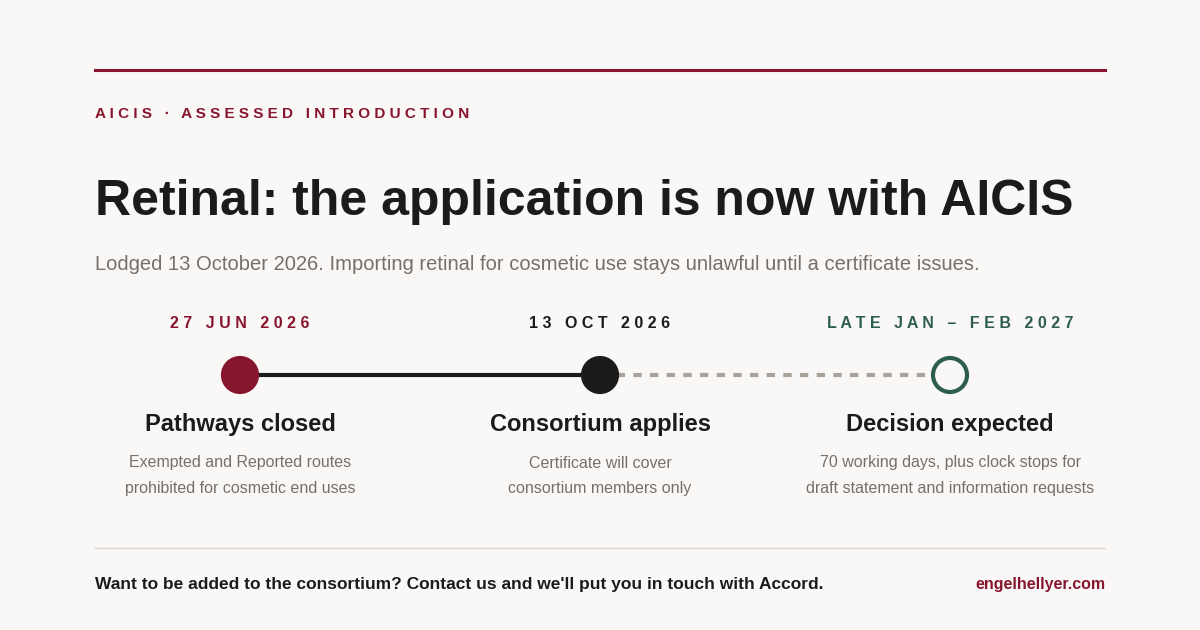
On 26 June 2026, AICIS published its final Evaluation of retinal (retinaldehyde). The outcome: the Exempted and Reported introduction pathways are prohibited for consumer end uses, including cosmetics and skincare, with effect from 27 June 2026 — the very next day.
For anyone importing retinal, either as a raw material or in a formulated cosmetic product, that means importation became unlawful essentially without notice. There was no transition period.
If you have retinal products in your range, or in your supply chain, this needs attention now.
What's actually changed
Retinal is a popular cosmetic active, and until this decision most introducers relied on the lower-burden Exempted or Reported categories. Those doors are now closed for consumer end uses.
The only remaining route is an assessed introduction — an individual AICIS assessment application. That is a materially different proposition:
- A health-focused assessment costs a minimum of around $24,100, before any additional data AICIS requests
- The assessment period is a minimum of 70 working days once lodged
- You may need to generate or license supporting toxicological data
One helpful point: AICIS has confirmed it will accept retinol reproductive toxicity data in support of a retinal application, on the basis that the reproductive toxicity profiles of the two are the same. That removes one potentially significant data barrier.
An odd asymmetry between importers and local manufacturers
There's a quirk worth understanding. Australian manufacturers using imported retinal raw material already in the country may continue manufacturing until that stock is exhausted. Importers of finished products have no equivalent runway.
AICIS has indicated it will take a "pragmatic approach" to stock already in transit, but has not said what that means in practice. That leaves genuine uncertainty for anyone with product on the water right now.
The Poisons Standard still applies separately
Worth remembering that this is an AICIS decision about introduction pathways. The Poisons Standard's existing Vitamin A entry, which caps retinal at 1% in cosmetic products, continues to apply regardless. Clearing the AICIS hurdle does not remove the scheduling requirement — both have to be satisfied.
The bigger lesson for anyone introducing chemicals
Set aside retinal for a moment. The broader implication is significant: AICIS has demonstrated it can withdraw the Exempted or Reported pathway for a chemical with immediate effect and little notice, following an evaluation outcome.
That changes how introducers should think about risk. A chemical sitting comfortably in a low-burden category today can be moved tomorrow if it appears on the Rolling Action Plan and the evaluation goes against it. AICIS recently commenced nine new evaluations, bringing the total underway to 14 — and genistein is among the chemicals where a similar outcome is possible.
Monitoring the Rolling Action Plan is no longer optional housekeeping. It's how you avoid finding out about a change the day it takes effect.
What to do now
- Establish whether retinal is in your range — finished products, raw materials, or anything in transit.
- Stop new imports of affected products pending a compliant pathway.
- Assess whether an assessed introduction is commercially viable for your volumes, and whether a shared or consortium application with other affected introducers makes the cost proportionate.
- Check the Rolling Action Plan for your other ingredients — retinal will not be the last chemical this happens to.
How Engel Hellyer & Partners can help
We work extensively on AICIS categorisation and assessed introductions, including consortium approaches where several introducers share the cost of a single application — often the only economic route when an ingredient moves into the assessed category.
Our staff have extensive regulatory experience including one who spent seven years at Australia's industrial chemicals regulator (NICNAS, now AICIS), so we understand how evaluations and assessment applications are handled from the inside as well as the outside.
If retinal is in your portfolio, or you'd like your ingredients screened against the Rolling Action Plan before the next evaluation lands, we're happy to take a look.
This article is general information only and does not constitute regulatory advice for any specific product or introduction. Requirements and regulator positions change; confirm the current position before acting.
Further reading
Primary sources from AICIS:

.svg)