
.svg)



Two deadlines, two periods, and a very common mix-up
If you import or manufacture industrial chemicals in Australia — and that includes the ingredients in virtually every cosmetic and personal care product — you have two separate AICIS obligations each year. They sound similar, they're a few months apart, and they cover different periods. Confusing them is one of the most common errors we see.
AICIS registration renewal — due 31 August. Your business registration expires on 31 August each year. If you're continuing to introduce industrial chemicals, you must renew before that date. The registration year then runs 1 September to 31 August.
Annual declaration — due 30 November. After the registration year closes, you declare that everything you introduced during that year was properly authorised.
So far, so straightforward. Here's where it trips people up.
The registration level is based on the financial year — not the registration year
When you renew, AICIS asks for the value of the industrial chemicals you introduced during the previous financial year — 1 July to 30 June. That figure determines your registration level (there are eight), which in turn determines what you pay: a flat fee for all introducers plus a charge that scales with introduction value.
But your annual declaration covers the registration year — 1 September to 31 August.
Same scheme, same business, two different twelve-month windows. If your records are set up around only one of them, you'll be reconstructing figures under time pressure — and the renewal deadline is the one with a hard cut-off.
This year there's a substantial discount — but only this year
The finalised 2026–27 Cost Recovery Implementation Statement brings a significant one-off change: registration levies for levels 2 to 8 are reduced by 90% for the 2026–27 registration year only. Levies return to indexed 2025–26 levels from 2027–28.
Two practical consequences:
- Renewing this year is unusually cheap if you sit in levels 2 to 8. Registration for 2026–27 is already open through the AICIS Business Services portal.
- Don't budget next year on this year's figure. The discount is explicitly temporary, so a business planning on the 2026–27 amount recurring will be caught short in 2027–28.
Note also that assessment certificate application fees and other fees for service increase from 1 September 2026 — so if you have an assessed introduction in the pipeline, the timing of lodgement matters.
The reduced levy does not change the obligation to calculate and report your introduction value correctly, which brings us to the second common error.
Getting the value right: landed cost, not invoice price
The other frequent error is undervaluing introductions. For imported cosmetic products and ingredients, the value AICIS is interested in is the landed cost — not simply what appears on the supplier invoice.
In practice that means accounting for:
- The customs value of the goods
- Insurance
- Freight
- Duty
Because your registration level — and therefore your fee — is tied to this figure, calculating it on invoice price alone can place you in the wrong tier. That's a compliance problem as much as a financial one: the declaration you sign should reflect an accurate value.
For businesses importing finished cosmetics, this is worth pausing on. Almost every ingredient in a cosmetic product is regulated as an industrial chemical, so the whole landed value of those imports is generally in scope.
What we do for clients
For clients whose products we already review, we manage the AICIS annual declaration process end to end — the registration renewal, the value calculations, the categorisation of introductions, and the declaration itself. Because we've already screened their formulations, we know what has been introduced and under which category, which is precisely what the declaration has to certify.
We also bring an unusual perspective to it. Director John Attard spent seven years at Australia's industrial chemicals regulator (NICNAS, now AICIS), where for around six of those years he managed the annual registration renewal process for approximately 6,000 registrants. That means we understand not only what the scheme asks for, but how the regulator processes, checks and scrutinises what you submit — including where errors most often arise.
It's a process that goes smoothly when the underlying compliance work has been done through the year, and becomes stressful when it hasn't.
We also monitor what's changing — because ingredients don't stand still
Registration and declaration are the annual rhythm. The ongoing work is watching for changes that affect whether your ingredients remain compliant at all. As AICIS regulatory affairs consultants, we track:
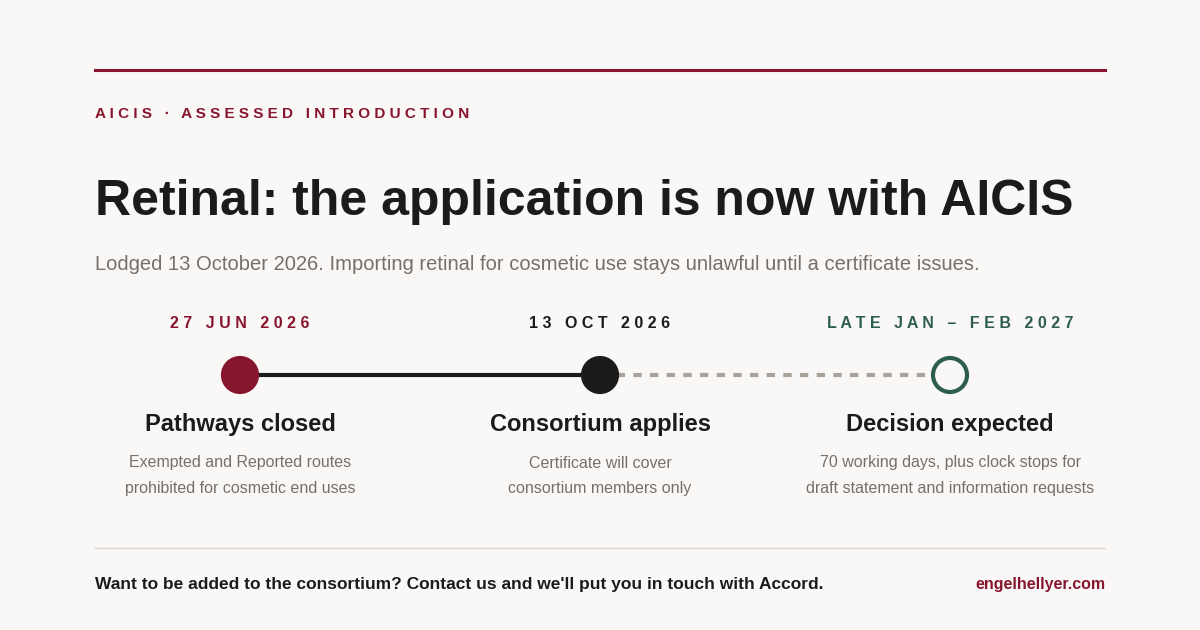
- AICIS evaluations and the rolling evaluation programme — including the treatment of retinal, which remains an access issue for cosmetic introducers and continues to be the subject of advocacy for a pathway onto the Australian Inventory of Industrial Chemicals.
- Changes to the Poisons Standard (SUSMP) — recent and pending decisions have touched ingredients used widely in cosmetics, including the broadened Schedule 6 entry for medium and long chain (C6–C15) alkyl sulfates, the interim decision on azelaic acid, new warning statements for methyl salicylate oils and extracts, and a pending decision on salicylic acid in dermal cosmetic preparations.
- Updates to the Australian Inventory of Industrial Chemicals (AIIC) and the AICIS Categorisation Guidelines, which determine which introduction pathway is open to you.
An ingredient that was comfortably compliant last year can be captured by a new scheduling entry or hazard listing this year. Monitoring is what turns that from a nasty surprise into a planned change.
Our AICIS and SUSMP services
Alongside AICIS compliance review, registration and annual declarations, we provide SUSMP / Poisons Schedule checking and categorisation — confirming whether your ingredients are scheduled, at what concentration cut-offs, and what warning statements, first-aid directions and labelling follow.
For most cosmetic and personal care businesses, those two pieces — AICIS and the Poisons Standard — are where compliance is won or lost.
What to do before 31 August
- Renew your registration before the deadline — the portal is open now.
- Calculate your introduction value on landed cost for the 2025–26 financial year (1 July – 30 June), including customs value, insurance, freight and duty.
- Use the AICIS registration calculator to confirm your level and apply the discounted 2026–27 levy.
- Check the timing of any assessment applications, given fees for service rise from 1 September 2026.
- Start assembling your annual declaration records for 1 September – 31 August now, rather than in late November.
If you'd like us to handle the renewal, the value calculation and the declaration — or simply to check your ingredients against the current Inventory and Poisons Standard — we're happy to take a look.
This article is general information only and does not constitute regulatory advice for any specific business or introduction. Requirements, fees and dates change; confirm the current position before acting.
Further reading
Primary guidance from AICIS:

.svg)